












QUICK SUMMARY
This blog breaks down the most common VoIP security threats, including toll fraud, call hijacking, SIP-based attacks, AI-driven vishing, and compliance risks. Read on to discover the vulnerabilities attackers target most often and the layered security measures organizations use to secure modern VoIP environments.
Right now, somewhere on your network, a sales call is happening. Pricing is being discussed. Contract terms are being negotiated. Customer details are being shared. The call sounds clear, and nobody suspects anything is wrong.
Meanwhile, a third party is listening via an unsecured SIP connection configured months ago and never reviewed. VoIP eavesdropping is not a theoretical risk. It is a real threat that can expose sensitive business conversations without warning.
As VoIP adoption grows, so do the security risks surrounding it. From toll fraud and call hijacking to data breaches and service disruptions, businesses need to understand where vulnerabilities exist and how to address them.
In this blog, we’ll cover the most common VoIP security risks and the practical steps businesses can take to prevent them.
Let’s begin with the basics of VoIP security and why it matters.
What is VoIP Security?
VoIP security refers to the technologies, policies, and practices used to protect voice communications over IP networks. It helps safeguard calls, user accounts, devices, and business data from threats such as DDoS, eavesdropping, toll fraud, malware, and unauthorized access.
Because VoIP operates over the internet rather than dedicated telephone lines, it offers greater flexibility and lower costs but also faces a wider range of security risks. Effective VoIP security helps organizations maintain service availability, protect sensitive information, and reduce exposure to VoIP attacks.
Why VoIP Security Matters?
Without proper security measures, VoIP systems can expose businesses to several operational and financial risks, including:
- Exposure of sensitive customer and business data
- Service disruptions that affect daily operations
- Financial losses from fraud and unauthorized usage
- Compliance violations and regulatory penalties
- Damage to customer trust and brand reputation
As businesses increasingly rely on cloud communications, securing VoIP infrastructure is essential to maintaining reliable, secure operations.
VoIP Security vs Traditional Phone Systems
| Factor | VoIP Systems | Traditional Phone Systems |
| Network Type | Operates over IP networks and the Internet | Operates over dedicated telephone networks |
| Flexibility | High scalability and remote accessibility | Limited flexibility and expansion |
| Attack Surface | Larger due to internet-connected devices | Smaller due to isolated infrastructure |
| Common Threats | Eavesdropping, toll fraud, malware, SIP attacks | Physical line tapping and hardware failures |
| Security Requirements | Requires encryption, access controls, and monitoring | Relies primarily on physical network security |
| Cost and Deployment | Lower infrastructure costs and easier deployment | Higher hardware and maintenance costs |
Understanding these differences helps businesses identify the security measures needed to protect modern VoIP environments.
VoIP threats are evolving faster than many security strategies. Build a stronger defense for your communications.
What are the Most Common VoIP Security Threats?
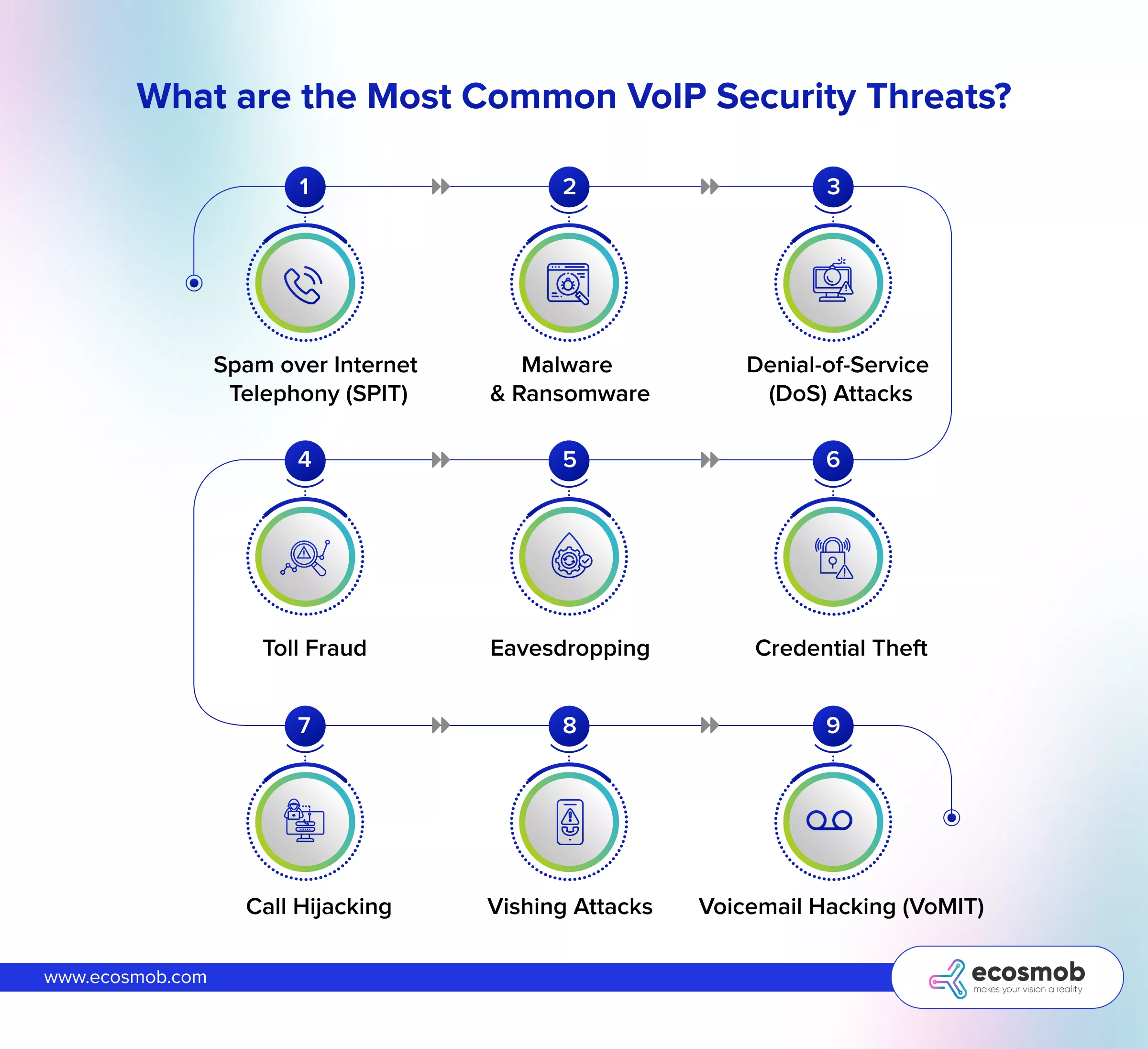
The most common VoIP security threats include toll fraud, eavesdropping, VoIP denial-of-service (DoS) attacks, vishing, malware, credential theft, call hijacking, SPIT, and voicemail hacking. These VoIP attacks can disrupt communications, expose sensitive data, and result in financial losses.
1. Toll Fraud
Attackers gain unauthorized access to a VoIP system and place expensive outbound calls. This is one of the most costly VoIP security risks for businesses.
2. Eavesdropping
Cybercriminals intercept voice traffic to listen to conversations. Sensitive customer, financial, or business information can be exposed without users knowing.
3. Denial-of-Service (DoS) Attacks
Attackers overwhelm VoIP servers or networks with traffic. This can degrade call quality or make communication services unavailable.
4. Vishing Attacks
Vishing uses phone calls to trick individuals into revealing passwords, account details, or other confidential information.
5. Malware and Ransomware
Malicious software can infect VoIP devices and communication systems. In some cases, attackers encrypt critical data and demand payment for its release.
6. Credential Theft
Weak or compromised credentials allow attackers to access VoIP accounts. Unauthorized access can lead to fraud, data theft, and service abuse.
7. Call Hijacking
Attackers take control of active calls and redirect or manipulate communications. This can compromise privacy and business operations.
8. Spam over Internet Telephony (SPIT)
SPIT involves large volumes of automated spam calls delivered through VoIP networks. These calls can reduce productivity and strain resources.
9. Voicemail Hacking (VoMIT)
VoMIT attacks target voicemail systems to access recorded messages and sensitive information stored within them.
Understanding these VoIP security threats is the first step in troubleshooting VoIP vulnerabilities before attackers can exploit them.
How Does Toll Fraud Happen in VoIP Systems?
Toll fraud occurs when attackers gain unauthorized access to a VoIP system and use it to place outbound calls at the organization’s expense. It is one of the most costly VoIP security threats and can generate significant charges before it is detected.
1. IRSF
In an IRSF attack, fraudsters route calls to premium-rate international numbers they control. The revenue generated from those calls is then shared with the attackers, resulting in substantial financial losses for the victim organization.
2. Dial-Through Abuse
Attackers compromise a PBX or VoIP account and use it as a gateway to make unauthorized long-distance or international calls. Weak passwords and exposed systems are common entry points for this type of abuse.
3. Attack Patterns
Many toll fraud attacks occur during weekends, holidays, or outside business hours. Attackers take advantage of reduced monitoring to place large volumes of calls before suspicious activity is noticed.
4. Business Impact
Toll fraud can lead to unexpected telecom expenses, operational disruptions, and reputational damage. In severe cases, businesses may face service restrictions while fraudulent activity is investigated.
Toll fraud is just one example of how attackers exploit VoIP systems. Many threats begin at the protocol level, making SIP-based attacks another critical area to understand.
What are SIP-Based VoIP Security Threats?
SIP-based VoIP security threats are attacks targeting the Session Initiation Protocol (SIP), which is responsible for establishing, managing, and terminating VoIP calls. Because SIP controls call signaling, attackers often exploit it to gain unauthorized access, disrupt services, or launch other VoIP attacks.
1. Registration Hijacking
Attackers intercept or manipulate SIP registration requests to impersonate legitimate users. This allows them to receive calls, make unauthorized calls, or access sensitive communications.
2. REGISTER Floods
In a REGISTER flood attack, large volumes of SIP registration requests are sent to overwhelm servers. This can degrade performance or prevent legitimate users from connecting.
3. INVITE Floods
Attackers send excessive SIP INVITE requests to overload the VoIP infrastructure. The resulting congestion can disrupt call processing and impact service availability.
4. SIP Scanning
Cybercriminals scan networks to identify exposed SIP devices, extensions, and servers. These findings are often used to launch credential theft, toll fraud, or other targeted attacks.
5. Endpoint Registration Abuse
Attackers register unauthorized devices on a VoIP network using stolen or weak credentials. Once connected, they can place fraudulent calls or intercept communications.
Encrypting SIP traffic is a critical first step in securing signaling, as many VoIP security threats originate at this layer before escalating into larger attacks.
What are RTP and Media Stream Security Risks?
RTP and media stream security risks are VoIP attacks that target the actual voice data exchanged during a call. If media streams are not properly secured, attackers can intercept, alter, or access sensitive conversations without disrupting the call itself.
1. RTP Injection
Attackers insert unauthorized audio packets into an active call. This can distort conversations or introduce misleading information into communications.
2. Call Interception
Cybercriminals capture voice traffic as it travels across the network. This allows them to listen to confidential conversations and gather sensitive information.
3. Session Manipulation
Attackers interfere with media streams to alter call behavior or redirect voice traffic. Such activity can compromise call integrity and user trust.
4. Data Exposure
Unencrypted voice traffic can expose customer information, financial details, and business discussions. The risk increases when communications travel across unsecured networks.
These VoIP security risks highlight the importance of protecting both call signaling and media traffic throughout the communication process.
How Are AI-Powered Voice Attacks Changing VoIP Security?
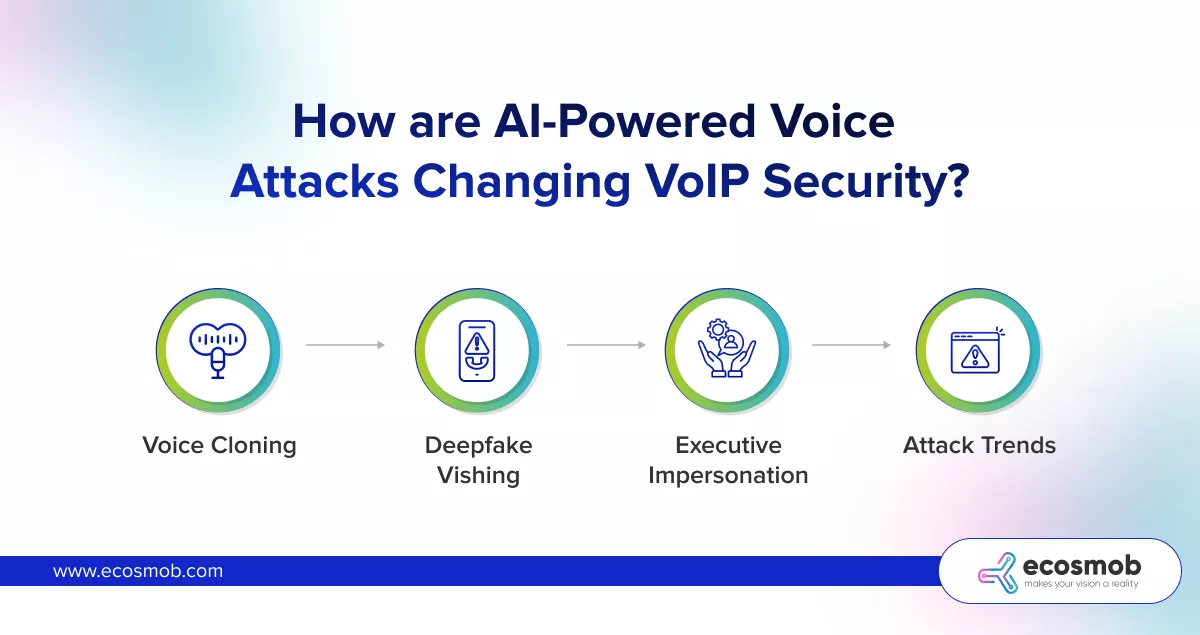
Powered by AI, synthetic Voice attacks are making VoIP security threats more convincing, scalable, and harder to detect. These attacks replicate human voices and automate social engineering tactics, enabling attackers to bypass traditional verification methods and increase the success rate of VoIP attacks.
1. Voice Cloning
AI tools can replicate a person’s voice using short audio samples. Attackers use cloned voices to impersonate employees, customers, or trusted contacts during phone conversations.
2. Deepfake Vishing
Deepfake vishing combines voice cloning with phishing tactics. Fraudsters use AI-generated voices to trick individuals into sharing credentials, financial information, or sensitive business data.
3. Executive Impersonation
Attackers often impersonate senior executives to create a sense of urgency and authority. Employees may be pressured into approving payments, sharing information, or granting access to critical systems.
4. Attack Trends
The rise of accessible AI tools has lowered the barrier to launching sophisticated voice-based attacks. As a result, organizations are seeing an increase in AI-driven vishing attempts and voice impersonation scams targeting business communications.
As VoIP threats continue to evolve, businesses must strengthen their security controls and user awareness to reduce the risk of AI-enabled attacks.
What are the Most Common Reasons for VoIP Security Vulnerabilities?
The most common VoIP security vulnerabilities include weak passwords, shared credentials, unpatched software, default settings, insecure devices, unsecured remote access, and outdated firmware. Attackers often exploit these gaps to gain unauthorized access, launch VoIP attacks, and compromise business communications.
1. Weak Passwords
Simple or predictable passwords make it easier for attackers to access VoIP accounts and systems through brute-force or credential-based attacks.
2. Shared Credentials
Using the same login credentials across multiple users reduces accountability and increases the risk of unauthorized access.
3. Unpatched Systems
VoIP platforms and applications that are not regularly updated may contain known security flaws that attackers can exploit.
4. Default Configurations
Default usernames, passwords, and security settings are common targets for cybercriminals seeking easy access to VoIP environments.
5. Insecure Endpoints
IP phones, softphones, and connected devices can become entry points for attackers if they are not properly secured.
6. Unsecured Remote Access
Remote users connecting through unsecured networks or devices can expose VoIP systems to interception and unauthorized access.
7. Outdated Firmware
Old firmware versions may contain vulnerabilities that remain unaddressed. Regular updates help reduce exposure to known threats.
Identifying these VoIP vulnerabilities is essential because most successful attacks begin by exploiting weak security controls rather than advanced techniques.
A single exposed SIP endpoint can create costly security risks. Secure your VoIP infrastructure end to end.
How Can Businesses Prevent VoIP Security Risks?
Businesses can reduce VoIP security risks by implementing layered security controls across their communication infrastructure. Combining encryption, access management, network protection, and continuous monitoring helps defend against common VoIP attacks and emerging threats.
1. Multi-Factor Authentication
Passwords alone are no longer enough to secure VoIP environments. Multi-factor authentication (MFA) requires users to verify their identity through an additional factor, such as a mobile app, security key, or one-time passcode.
This additional verification step makes it more difficult for attackers to access VoIP accounts, even if login credentials have been compromised. MFA is particularly important for administrative accounts, remote users, and cloud-based communication platforms.
2. Access Control
Not every employee requires the same level of access to a VoIP system. Applying role-based access control (RBAC) helps organizations limit permissions according to specific responsibilities.
Restricting administrative privileges reduces the likelihood of unauthorized configuration changes and minimizes the potential impact of compromised accounts. Access permissions should also be reviewed regularly to ensure former employees and inactive users no longer retain access.
3. Encryption
VoIP Encryption is one of the most effective VoIP security solutions for protecting communications in transit. Without encryption, attackers may be able to intercept signaling traffic or capture voice conversations moving across a network.
Transport Layer Security (TLS) helps secure SIP signaling, while Secure Real-Time Transport Protocol (SRTP) protects voice media streams during active calls. Together, these protocols help prevent eavesdropping, call interception, and unauthorized access to communication data.
4. Session Border Controllers
Session Border Controllers (SBCs) play a critical role in securing VoIP networks. Positioned at the boundary between internal systems and external networks, SBCs inspect and control voice traffic before it reaches the communication infrastructure.
They help prevent unauthorized access, enforce security policies, manage call routing, and reduce exposure to SIP-based attacks. SBCs also provide an additional layer of protection against denial-of-service attempts and other malicious traffic.
5. Firewalls and Intrusion Prevention
Traditional firewalls help control which traffic can enter and leave a network. For VoIP environments, organizations should use security controls capable of understanding and filtering voice-related protocols.
Intrusion Detection Systems (IDS) and Intrusion Prevention Systems (IPS) add another layer of protection by monitoring network activity for suspicious behavior. These tools can identify unusual traffic patterns and respond before attacks affect service availability.
6. SIP Security
Because SIP is responsible for establishing and managing VoIP calls, it is a common target for attackers. Organizations should restrict SIP access to trusted networks and authorized devices whenever possible.
Additional measures such as traffic filtering, rate limiting, and registration controls can help reduce the risk of SIP scanning, registration hijacking, and signaling-based attacks.
7. Call Restrictions
Toll fraud remains one of the most expensive VoIP security threats for businesses. Restricting access to international destinations, premium-rate numbers, and high-risk calling routes can significantly reduce exposure.
Call permissions should align with business requirements rather than being enabled by default. Regular reviews of call activity can also help identify unusual usage patterns before costs escalate.
8. Network Segmentation
Separating voice traffic from general data traffic helps improve both security and performance. Organizations commonly achieve this through dedicated voice VLANs that isolate communication systems from other network resources.
Network segmentation limits the movement of threats across the environment and reduces the likelihood that a compromise in one area will affect voice services.
9. Security Monitoring
Continuous monitoring is essential for detecting VoIP attacks before they cause significant damage. Monitoring tools can track call records, login activity, registration attempts, and network behavior for signs of suspicious activity.
Automated alerts allow security teams to investigate unusual patterns quickly and respond before threats escalate into larger incidents.
10. Employee Awareness
Many VoIP security incidents begin with social engineering rather than technical vulnerabilities. Attackers frequently use phone calls, voice messages, and impersonation tactics to manipulate employees into revealing information or granting access.
Regular security awareness training helps employees recognize vishing attempts, executive impersonation scams, and other voice-based threats. Educated users often serve as the first line of defense against evolving attack techniques.
Protecting a VoIP environment requires more than a single security tool. Organizations that combine strong technical controls, ongoing monitoring, and user awareness are better equipped to defend against modern VoIP security threats.
What Compliance Standards Apply to VoIP Security?
Several compliance standards apply to VoIP security, depending on the industry, geographic location, and type of data being handled. These frameworks help organizations protect sensitive information, strengthen security controls, and meet regulatory requirements.
1. HIPAA
Organizations handling protected health information (PHI) must comply with HIPAA requirements. VoIP systems used in healthcare should support safeguards that protect patient data and communication records.
2. PCI DSS
Businesses that process, store, or transmit payment card data must comply with PCI DSS. Secure voice communications and access controls play an important role in protecting payment information.
3. SOC 2 Type II
SOC 2 Type II evaluates how service providers manage security, availability, confidentiality, and data protection controls over time. It is commonly used to assess the security posture of cloud and VoIP providers.
4. ISO 27001
ISO 27001 is an internationally recognized standard for information security management. It provides a structured framework for identifying risks and implementing security controls.
5. GDPR
Organizations handling personal data of individuals in the European Union must comply with GDPR requirements. VoIP providers and businesses must ensure that customer data is processed and protected appropriately.
6. STIR/SHAKEN
STIR/SHAKEN helps verify caller identities and reduce illegal caller ID spoofing. It plays an important role in improving trust and security in voice communications.
7. Service Providers
VoIP service providers should evaluate compliance requirements based on their customers, operating regions, and services offered. Certifications such as SOC 2 Type II, ISO 27001, and PCI DSS can demonstrate a strong commitment to security and compliance.
8. Enterprises
Enterprises should ensure that their VoIP provider supports relevant compliance requirements for their industry. Security controls, audit capabilities, data protection measures, and regulatory support should all be considered during vendor evaluation.
Compliance alone does not guarantee security, but it provides a strong foundation for managing VoIP security risks and protecting sensitive communications.
Protecting voice traffic requires more than a firewall. Secure every layer of your VoIP ecosystem.
VoIP Security Best Practices Checklist
The most effective VoIP security best practices combine strong access controls, secure network configurations, continuous monitoring, and employee awareness. Use the checklist below to assess your current security posture and identify areas for improvement.
Identity Security
Network Security
Endpoint Security
Monitoring and Detection
Compliance Management
Employee Awareness
Following these VoIP security best practices can help organizations strengthen their communication infrastructure, reduce security risks, and improve resilience against evolving VoIP attacks.
By now, you understand the key VoIP security threats, vulnerabilities, and measures needed to reduce risk.
The Bottom Line?
VoIP security is no longer just an IT concern. It is a business necessity. From toll fraud and SIP-based attacks to AI-powered voice scams, modern threats can impact finances, operations, and customer trust if left unaddressed.
The good news is that most VoIP security risks can be significantly reduced through a combination of strong security controls, continuous monitoring, compliance readiness, and employee awareness. A proactive approach helps businesses protect their communications and stay ahead of evolving threats.
At Ecosmob, we deliver secure and reliable VoIP solutions designed to support evolving business communication needs.
FAQs
Is VoIP secure for business communications?
Yes, VoIP can be highly secure when protected with encryption, access controls, session border controllers (SBCs), and continuous monitoring. However, like any internet-based system, it requires proper security measures to reduce risks.
What is the biggest VoIP security threat?
Toll fraud is one of the most costly VoIP security threats. Attackers gain unauthorized access to VoIP systems and use them to place fraudulent outbound calls, often resulting in significant financial losses.
How can businesses prevent VoIP attacks?
Businesses can reduce VoIP security risks by implementing MFA, encrypting SIP and RTP traffic, deploying SBCs, restricting access, monitoring call activity, and training employees to recognize social engineering attacks.
What is SIP hijacking in VoIP?
SIP hijacking occurs when attackers manipulate SIP registration requests to impersonate legitimate users or devices. This can allow them to intercept calls, place unauthorized calls, or gain access to communication systems.
Why is encryption important for VoIP security?
Encryption protects call signaling and voice traffic from interception. Protocols such as TLS and SRTP help prevent eavesdropping, call interception, and unauthorized access to sensitive communications.